ARTIST STATEMENT
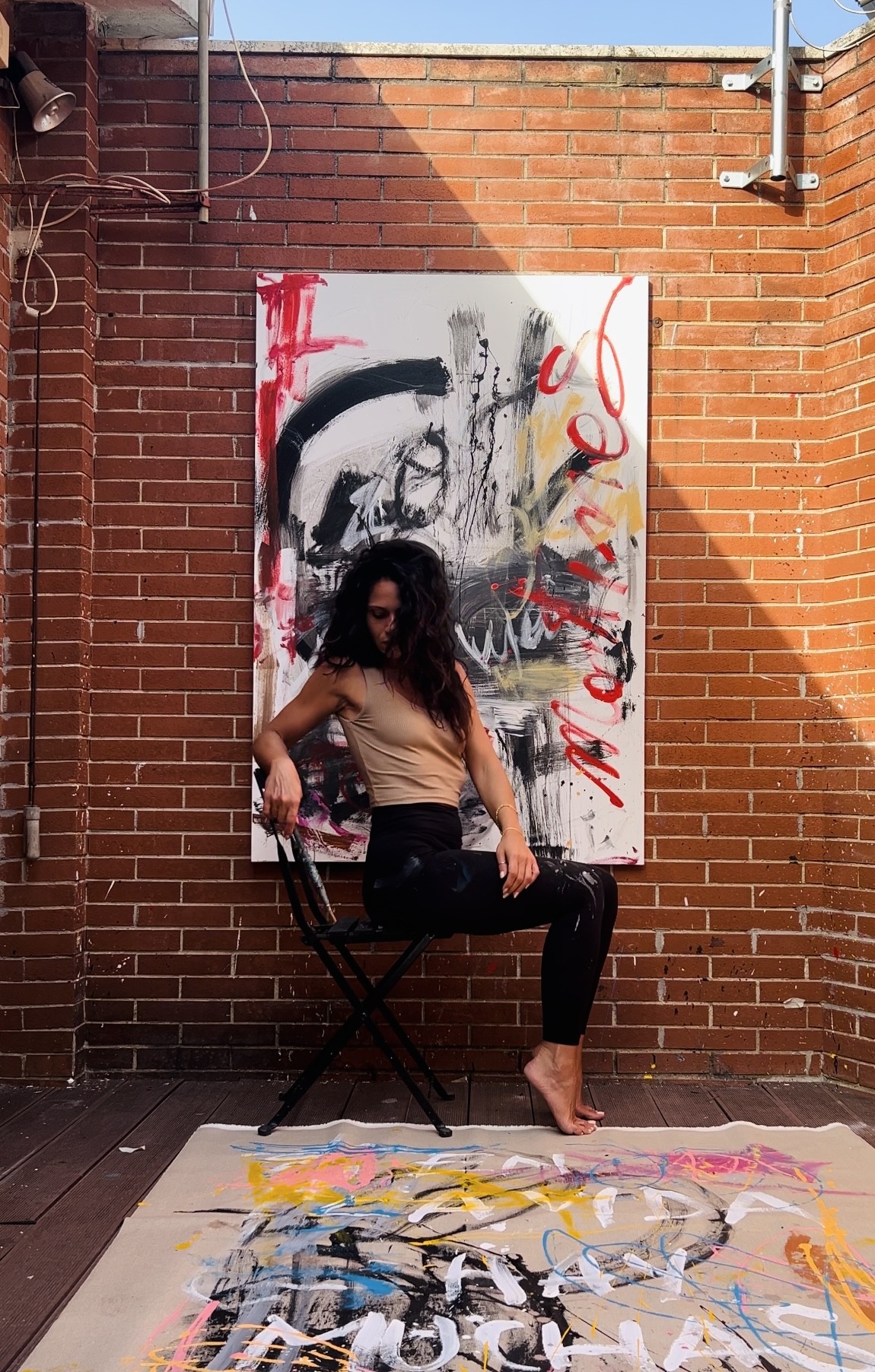
“My painting rejects predetermined form in order to become body, matter and energy. The driving force of my research lies in lived human emotion: joys, traumas and fragilities are decoded and poured onto the canvas. In an intimate and total gesture, the conscious mind is eclipsed, letting the body become a pure instrument in the service of the subconscious.
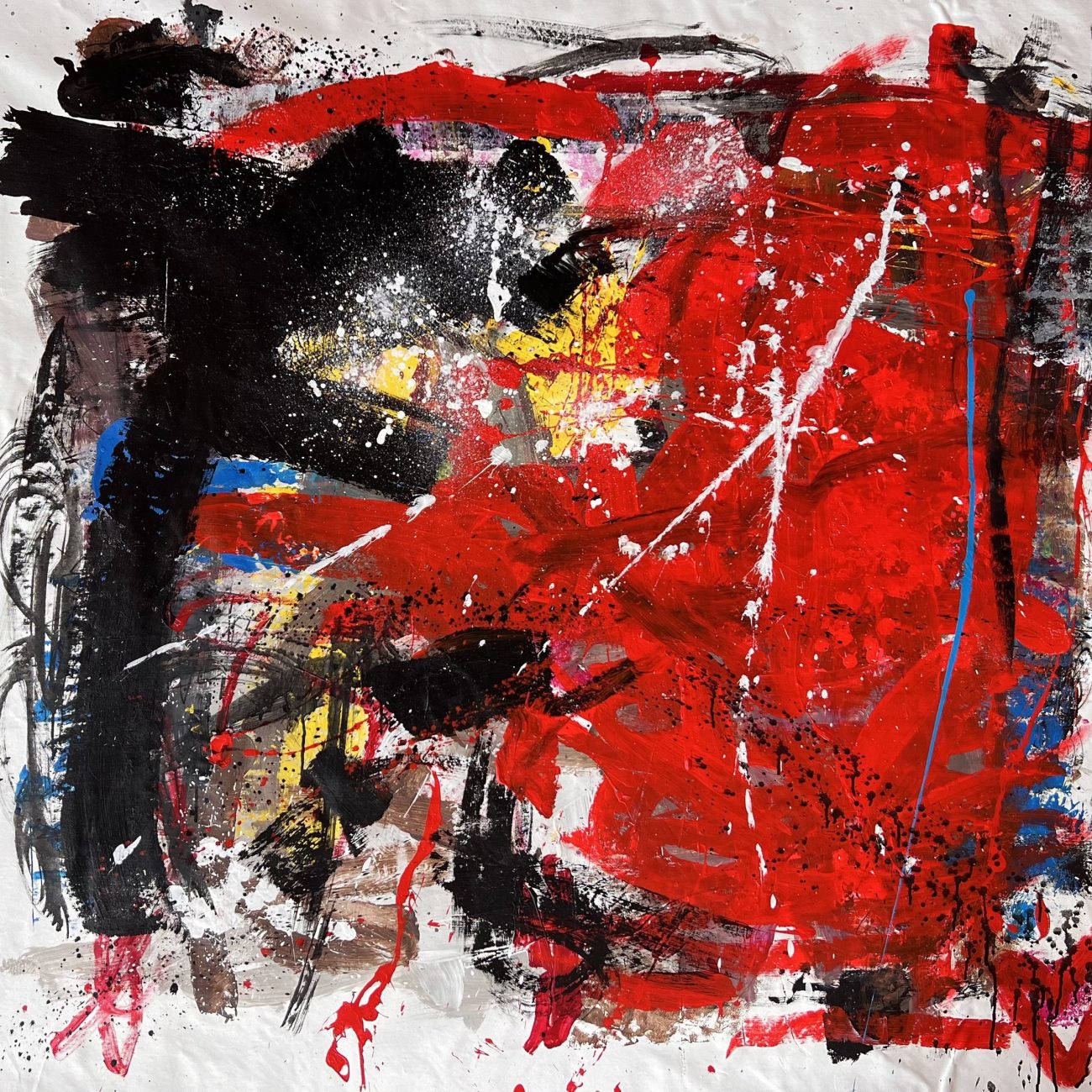
I conceive the canvas as a place of sedimentation, where I combine the tactile density of sand with the glassy fluidity of enamels and resins, setting them against the opacity of pure pigments. Through incision and graffito, I attack and break the surface to reveal the memory of the layers beneath. The work does not describe a figure; it creates an immersive emotional experience: a controlled chaos in which viewers can recognise a fragment of their own humanity.”
Hers is a path of continuous experimentation, aimed at exploring the infinite possibilities of the painterly medium. The result is an intense painting, often material and always mature, in which the aesthetic and conceptual dimensions move forward together. Martines works with oil, acrylic, enamel, natural pigments and metal, often on raw canvas. For her, colour carries a strong symbolic value, as in the confrontation between black and red, or in white as completeness.
The themes of her work touch on identity, eros, the feminine, the conflict between vice and virtue, self-knowledge and the freedom won through study. At the centre there is always a tension: to move beyond the condition of a mere artist and become a master.
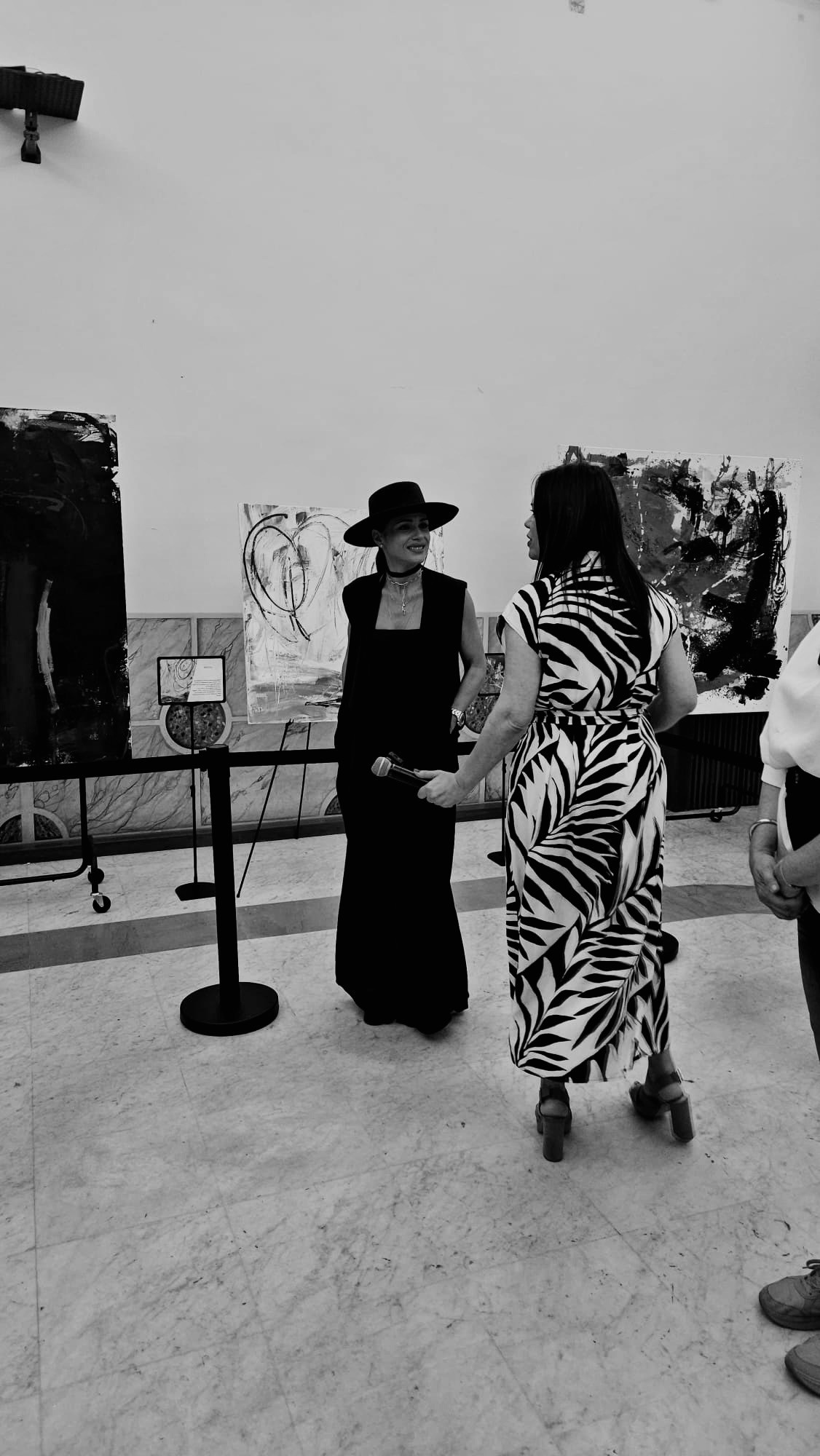
With her first solo exhibition, Katharsis, Martines presents a journey of liberation and purification, an almost ascetic path. Along this path, painting becomes a new expressive dimension and a search for the self. The works on show, created between 2023 and 2026, retrace its stages: Infanzia, Eros, Identità, Vitium, Femininum, Temet Nosce, Libero Arbitrio and Experimentum.
Biography
From figure to Art Informel
A contemporary painter and visual artist, Francesca Diana Martines pursues a body of research that explores the primordial bonds between matter, memory, the body and informal abstraction.
Roots and training
She was born in Rome on 7 August 1989 and grew up in an environment saturated with visual stimuli and intellectual ferment. Art runs in the family: her father, Alberto Diana, was an artist close to the Scuola Romana of the 1970s and a regular presence in its circles. From him she inherited a love of art, colour and form.
The fluidity of the body and Eros
2013 marks her first major expressive turning point. The academic rigidity of her early work gradually gives way to a gestural, instinctive painting, and the brush becomes the instrument of an investigation into fluidity: colour turns into living matter, dissolving into soft volumes and vibrant surfaces that reflect light like bodies of water.
The female nude becomes her subject of choice. On the canvas, flesh is crossed by polychrome tremors that transfigure anatomy into a soft, languid and sensual substance. The result is a painting of strong emotional tension, always poised between Eros and Pathos, sacred and profane, light and shadow: the testimony of a search in which spirit and body are inseparable.
A cosmopolitan axis and a new name
Between her permanent studio in Rome and travels to the Caribbean, Berlin, London, Spain, Mexico and Ibiza, the artist’s painterly and theoretical horizons widen. The saturated colours, atmospheres and cultures of the Hispanic and Latin world awaken in her a deep sense of belonging to distant origins. At this moment of personal maturity she chooses to add her mother’s surname to her signature: signing as Francesca Diana Martines becomes an act of genealogical and poetic reclamation, uniting her Roman roots with those of her origins.
In the same period her painting leaves academic figuration behind and ventures into the territory of pure abstraction. Signs, forms and colours no longer arise from calculation or the observation of reality, but from the emotional intuition of the hand, which surrenders on the canvas to a true “stream of consciousness”: a ritual dance in which body, soul and music merge.
Creative seclusion and the Artemide collection
With the COVID-19 pandemic in 2020, the artist is forced to reorganise her daily and professional life profoundly, and moves her studio into her home. As if to overcome the oppression of lockdown, she breaks through the limits of domestic space and turns it into a visionary place, where the large-scale canvases commissioned from her in that period come to life.
In the climate of enforced isolation a new phase blossoms, guided solely by the exploration of the inner world. The Artemide collection takes shape, a body of work born from a series of synchronous events: the name of the lunar goddess deliberately recalls her father’s surname, Diana. The artist temporarily sets the nude aside to focus on the cycles of nature and the phases of the moon. From September 2020 her canvases fill with cosmic visions and symbols of the sacred feminine, turning isolation into a hymn to the generative force of the universe. The cycle continues until 2022.
The Pop interlude and chromatic impact
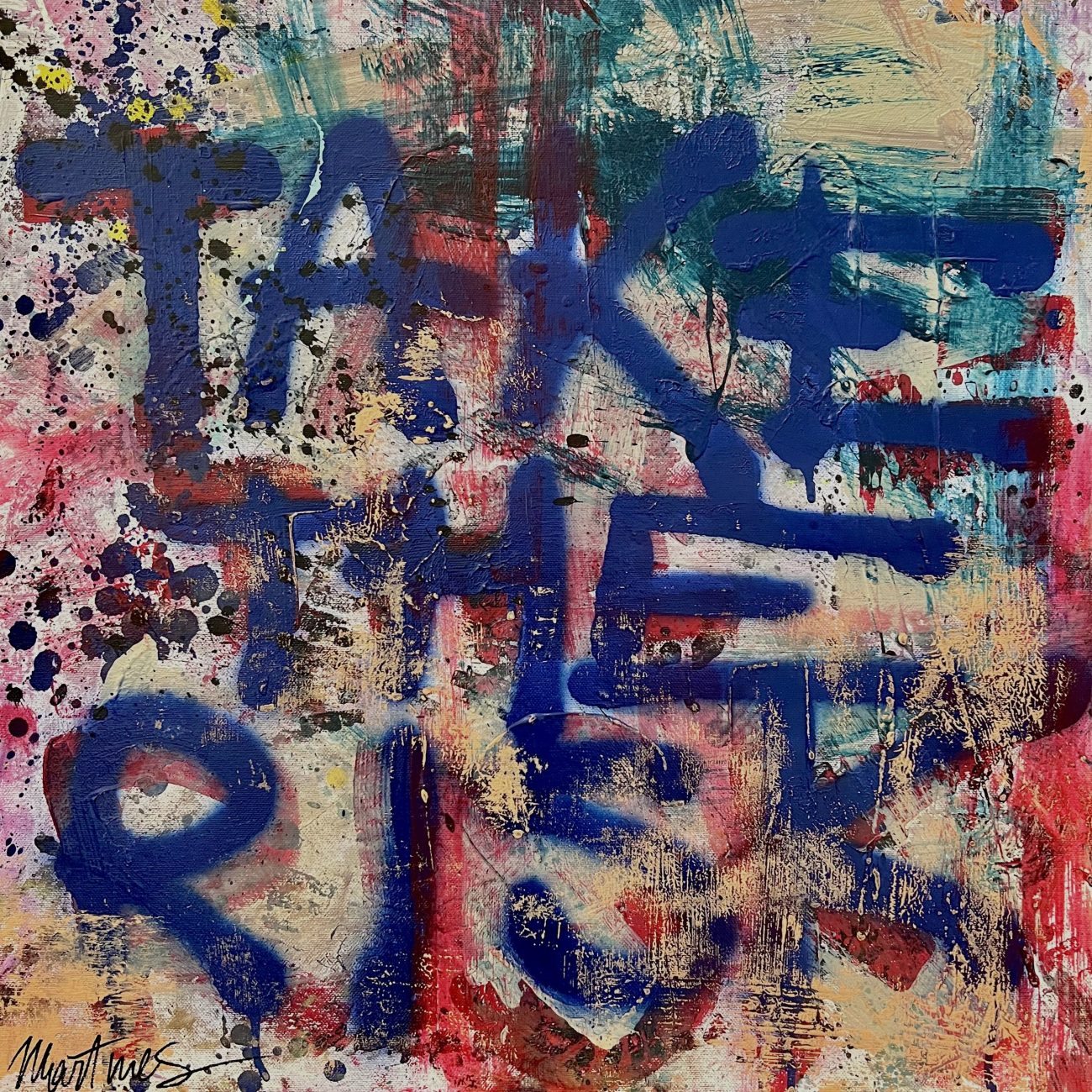
2022 brings a new and sudden revolution in method. The artist contaminates her academic training with the codes and provocations of Pop Art. In an irreverent and regenerating creative frenzy she reworks paintings from previous years and overturns their rigour, adding writing, keywords, tags and splashes of pure colour, born from immediate and instinctive gestures.
This phase, with its powerful chromatic impact and eclectic, contemporary taste, leads her to completely rethink the structure and atmosphere of her studio, following an irrepressible need for emotional and formal renewal.
Recognition and the turn to Art Informel
2023 is the year of public recognition. With the work Gravidanza Bionica the artist wins the Artista d’Europa Prize, a success that opens the doors of the historic Galleria Antonio Battaglia in Milan’s Brera district, where the work is exhibited to keen critical interest.
Full maturity arrives in 2024 with a decisive encounter: a visit to the Maestro Giorgio Celiberti in his studio in Udine. His stories of avant-garde painting after the Second World War, of the historic 1948 Venice Biennale and of his close friendship with Emilio Vedova deeply shake her painterly consciousness. Recognising in herself a profound expressive urgency, she chooses the path of Art Informel. In the same year she takes part in a group exhibition at the Galerie Thuillier in Paris.
The gesture becomes energetic, material, purely emotional. Large-scale works emerge, made of layers of pure pigment and violent abrasions. Memory is now at the heart of her investigation: the canvas becomes a battlefield on which the artist digs between matter and creation to discover what resists time and the destructive act of erasure.
Institutional consolidation
2025 is a year of transition, study and research into the movement of the body within the pictorial space, in which the artist gathers her energy for her institutional debut.
In 2026 her research finds full expression in two important events in Rome, both curated by the art historian Nicoletta Rossotti: the group exhibition Pathos at the Galleria Angelica and her first solo exhibition, Kátharsis, staged in the institutional rooms of Palazzo Valentini. Two events that mark her definitive entry into the national contemporary art scene. In the same year she takes part in the group exhibition Anatomie del segno at Palazzo dell’Emiciclo in L’Aquila.
Exhibitions
Essential chronology
Artista d’Europa Prize — Galleria Antonio Battaglia, Milan.
Award-winning work: Gravidanza Bionica.
Group exhibition — Galerie Thuillier, Paris.
Pathos, group exhibition — Galleria Angelica, Rome.
Under the patronage of Roma Capitale.
Kátharsis, solo exhibition — Palazzo Valentini, Rome.
Under the patronage of Roma Capitale.
Anatomie del segno, group exhibition — Palazzo dell’Emiciclo, L’Aquila.
The 2026 exhibition projects are curated by Nicoletta Rossotti, art historian, curator and national coordinator of the art section of the Accademia Medicea in Florence.